


Two smiling young women lean together in a sunny park, one in headphones and a blue tee, the other in a green bucket hat.
Blue and white gradient background with soft, circular light patterns.Blue and white gradient background with soft, circular light patterns.
Specialized Care for Teens | Ages 13 to 17

Therapy for Teens With Anxiety and OCD

InStride’s therapy for teens treats anxiety, OCD, and related disorders, with evidence-based care delivered virtually. Over 4 to 8 months, treatment works toward self-set goals with the support of a dedicated, 3-person care team.
In-network with major insurers

Care You Can Access

99% of families utilize health plan coverage for InStride services.* Our team will confirm coverage during the application process.
*We do not currently accept Medicaid.

What Anxiety and OCD Look Like in Teens

Anxiety and OCD can blend into the ups and downs of being a teenager. The signs are often everyday behaviors: backing out of plans, checking things over and over, avoiding school situations, or needing to feel sure before moving on.

Home and Family

Lying awake with "what if" worries about the future, or searching online for worst-case answers
Asking the same question over and over for reassurance
Spending far longer washing, showering, or cleaning than needed
Redoing small things, like walking through a doorway or zipping a jacket, until it feels right
Snapping at siblings or getting irritable in the days before a big test
Texting family over and over to make sure everyone’s okay
Relying on a parent to make calls, order food, or change plans

School, Friends, and Phones

Backing out of a summer job interview, a driving lesson, or a club that sounded exciting at first
Dreading a big test until staying home feels like the only option
Turning down time with friends to keep studying
Avoiding the cafeteria, group conversations, or meeting new people
Worrying for days before a party, then canceling the day of
Posting something, then checking for likes and replies repeatedly
Avoiding class presentations or raising a hand

Signs It's More Than Everyday Teenage Stress

These are the moments that tell you this is worth getting help for, and each one is something treatment can change.

A thoughtful teenage girl in glasses rests her chin on her hand while sitting on a gray couch by a window.

When it gets in the way

Anxiety or OCD starts taking up space in school, friendships, sleep, and the things that matter most. Plans and opportunities that once felt exciting get pushed aside, and more of the day gets organized around avoiding the worry.
A mother and a teenage girl sit cross-legged on a sofa, talking face to face in a bright home.

When it runs the show

Checking once is never quite enough; one more look or one more “what if” always follows. More and more time and energy, often the whole family’s, goes toward getting certain instead of getting on with what matters.
A teenage boy, eyes closed and smiling, shares a warm hug with his mother in a cozy living room.

When it doesn't pass

Instead of passing after a tough week or semester, it keeps coming back, gets stronger, or spreads into new parts of life. The distress is real, and it’s clear this is more than a stressful phase that will pass on its own.
If these moments feel familiar, InStride can help. Get started today, and our team will help you understand what's happening and what comes next.

How Treatment Works for Teenagers

Online therapy for teens with anxiety, OCD, and related disorders uses the same proven approach across every age. For ages 13 to 17, it's delivered in a way that puts teenagers at the center of their treatment.
1

Taking back control

Treatment is built around each teen and what matters most to them. The goal is getting back in the driver’s seat, with decisions made by the person living their life, not by anxiety or OCD. Live sessions build on proven Cognitive Behavioral Therapy (CBT) strategies, including exposure therapy, tailored to personal goals and values.

2

Motivation comes first

No matter where a teen is at, InStride's care team helps figure out where things stand and what kind of life feels worth working towards. Then they work together to build goals and a plan that feels doable.

3

What an exposure looks like

Exposure means gradually facing what anxiety or OCD has made hard. Working with the care team, each teen builds a plan, rates every step for fear and willingness, and moves at a pace that feels right. Someone who keeps canceling plans might start by replying to a friend, then grab food with one friend, and work up to staying at a party.

4

How it fits a teenager's life

Treatment happens online and is purposefully time-bound, typically 4 to 8 months, so it fits around school, sports, and friends. A dedicated exposure coach is also available by phone and text between sessions, in the moments anxiety and OCD show up. Real clinical vocabulary is taught rather than talked around, so teenagers understand their own care.

Blue curved line forming a loop and flowing vertically against a transparent background.

What a Week of Treatment Looks Like

A typical week includes one-on-one therapy, exposure coaching, and psychiatry, all from one coordinated team. Everything follows a single treatment plan, and sessions are paced so there's time to put new skills into practice in daily life.
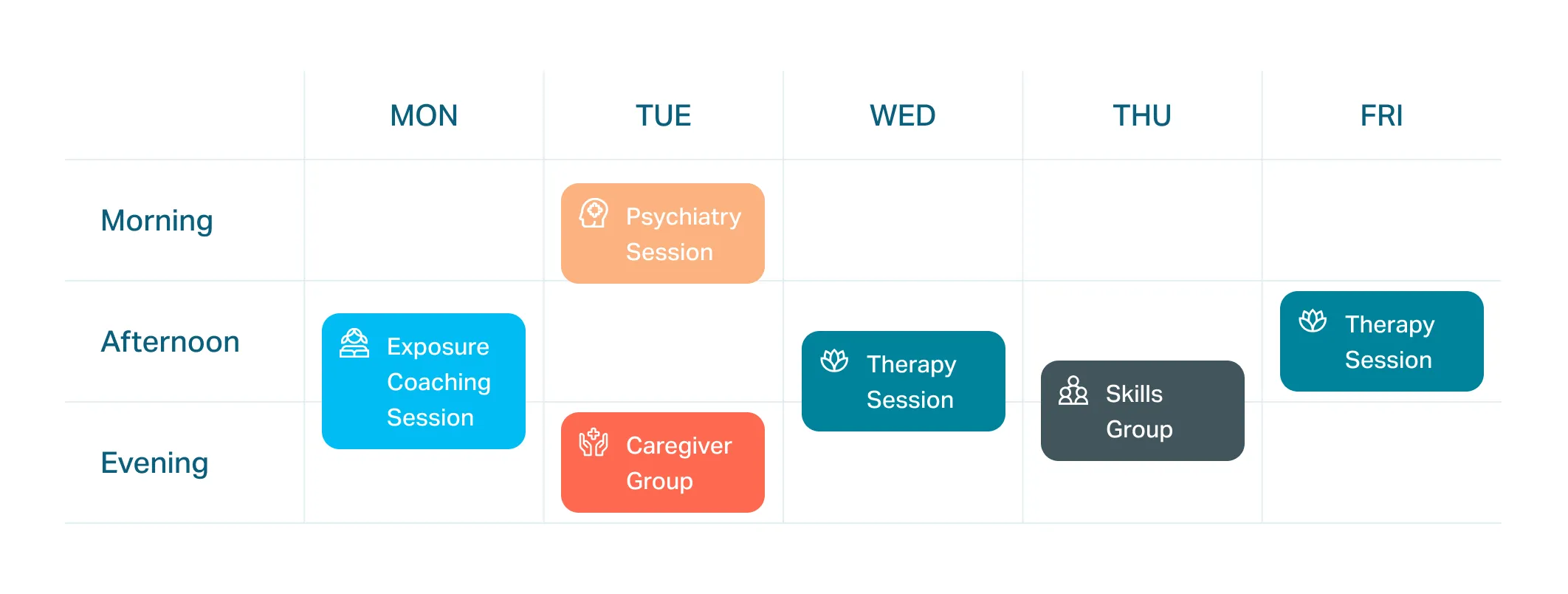
Calendar

*Illustrative Phase 1 schedule. Session frequency decreases in Phase 2. Every care plan is personalized to individual needs, age, and goals, and the therapist adjusts it as milestones are reached.

What Progress Looks Like for Teens at InStride

97
%

of graduates experience clinical improvement*

9
 in
 10

reported reduction in anxiety symptoms, with significant reductions observed as early as two months*

9
 in
 10

report reduced depression symptoms*

96
%

would recommend InStride to a friend*

62
%

of graduates discharged without continued therapy*

<
 3
 days

average wait time between application acceptance and meeting with an InStride clinician*

Meet the Care Team

Every teenager at InStride works with three dedicated specialists, all coordinating on one plan, and has a real say in shaping what their care looks like.

Therapist

The therapist uses the initial evaluation to map out a treatment plan built around each teenager’s own goals. They teach the skills needed to respond differently to anxiety, OCD, and related disorders, and update the plan as milestones are reached and goals evolve.
The therapist also keeps everyone, including the family, coordinated on one plan.
Woman lying on a couch engaging in a video call with a smiling professional on a laptop screen.

Exposure coach

The exposure coach helps each teenager practice the CBT skills learned in therapy, with a focus on exposure therapy. Together, they work through exposures in the situations where anxiety and OCD actually show up: school, social plans, or a first shift at work.
Between sessions, the coach is a text or call away whenever things feel stuck or a motivation boost would help.
Teenager with curly hair wearing black headphones, light blue hoodie, gray joggers, and red sneakers sitting on the floor while looking at a smartphone.

Psychiatrist

Working alongside the therapist and exposure coach, the psychiatrist helps explore whether medication could help, or reviews and adjusts any current medication.
Teenagers are part of that conversation, and the psychiatrist provides clear guidance so the whole family can make an informed decision.
An older woman in glasses takes notes in a notebook beside her laptop and coffee mug on a sofa at home.

Teen

Every teenager is a key member of their own care team and the true expert on themselves. No one knows their life better, so speaking up about what’s working, what isn’t, and what support helps most is always encouraged.
Personal goals and values shape the plan from day one. Treatment is about the life each teen wants to build, and every step forward is their own.
A cheerful teenage girl with a swinging ponytail, gray hoodie and yellow backpack straps smiles outdoors under a blue sky.

How Families Support a Teen in Treatment

Treatment is a team effort between the teen, the family, and the care team. Teenagers lead the way, and families learn how to support that progress at home.

When anxiety or OCD shows up, it’s natural for families to step in. A parent might make the phone call or answer the same “what if” one more time. These moments come from love, but over time they can make it harder to learn that uncomfortable feelings are manageable.
Teenagers identify where anxiety or OCD has pulled others into helping them avoid, while parents work with the care team on when and how to step back. And because the plan is built around the teenager’s own goals, not anyone else’s, every step has a real reason behind it.
The goal is for families to support growing independence, during treatment and long after.

What We Treat in Teens

No two teenagers experience anxiety and OCD the same way. InStride treats the full range, both the familiar forms and those that commonly go unrecognized.

GAD Icon
Generalized Anxiety Disorder (GAD)
OCD Icon
Obsessions and Compulsions (OCD)
Emetophobia Icon
Social Anxiety
Panic Attacks Icon
Panic Attacks
Social Anxiety Icon
Health Anxiety
Social Anxiety Icon
Emetophobia
Health Anxiety Icon
Separation Anxiety
School Icon
School Avoidance
Perfectionism Icon
Perfectionism
Academic Anxiety Icon
Academic Anxiety
Academic Anxiety Icon
Selective Mutism
Fears/Phobias Icon
Fears (of Crowded Places, Needles, Vomiting, etc.)
Academic Anxiety Icon
Tics
Hair-Pulling Icon
Hair Pulling (Trichotillomania)
Skin-Picking (Excoriation) Icon
Skin Picking (Excoriation)
ARFID (Eating-Related Fears) Icon
Eating-Related Fears (ARFID)
Hair-Pulling Icon
Obsessive Concerns About Body Features (BDD)
PANS/PANDAS Icon
PANS and PANDAS
Academic Anxiety Icon
Agoraphobia
Many teens come to InStride with anxiety or OCD alongside other conditions like ADHD, depression, or autism.
When anxiety or OCD are primary, our program treats the full picture. Not sure? Apply and let our team determine the best path forward.

Lasting Change for Teens Living With Anxiety and OCD

Here's what teens and their families have said about InStride.

“Deep down, I knew I needed help, I just wouldn’t admit it. Then I found InStride.”

“What really made my mom want to get me help was when I was about to go to overnight camp, and I was just too anxious and I wouldn't get out of the car. I had three different people that I was working with, a coach, a psychiatrist, and my favorite, my therapist. She was someone that I could fully trust, and I looked forward to the sessions every week. My favorite metaphor was, you're in the driver's seat, anxiety's in the passenger seat. This summer, I went to overnight camp for eight days, and I think that was like the finish line for me. I felt like I just won.”

Avery
InStride Health graduate

“Our daughter was really struggling.”

“She had withdrawn, was scared of everything, and it was beginning to affect the whole family. But then we found InStride. After my daughter learned to control her OCD our family life became MUCH more manageable. Your kid doesn’t just sit and talk to a counselor, they have an entire team to help! The exposure therapy helped her face her fears head-on, like walking past crowds on the sidewalk or even going to school every day."

Denna
Parent of InStride Health graduate

"I struggled with general anxiety disorder.”

“Which affected my daily life through sleep loss, panic attacks, and obsessive control habits. I knew I needed support, and with my family’s help, I found InStride, where I worked with a therapist, coach, and psychiatrist. Through the InStride program, I learned effective coping strategies for both social and academic anxiety. Now, I can confidently say it transformed my mindset and made me a better person—not just for myself, but also for my friends and family."

InStride Health graduate

Frequently Asked Questions

What if my teen doesn't want treatment?

Plus icon

Not every teen arrives convinced they need help, and the program is designed with that in mind. Your teen's care team begins by exploring what matters to them and what they want their life to look like. When the goals come from your teen, hesitation often turns into participation.

Will I know what my teen talks about?

Plus icon

Through your own conversations with the care team, you'll understand what your teen is working on and learn how to support them at home, including when to step in and when to step back.

Can this be done around school, sports, and a job?

Plus icon

Because InStride is fully virtual, sessions can be scheduled around classes, practices, and work shifts. The exposure coach can even work in those settings, so they become places to practice rather than things treatment pulls them away from.

Is a formal diagnosis needed to apply?

Plus icon

No. Our team starts with a full evaluation to understand what's going on and whether InStride is the right fit. When anxiety or OCD is the primary concern, with or without a formal label, the evaluation helps map out the best next step.

Therapy has been tried before and it didn't work. Why would this be different?

Plus icon

Many teens come to InStride after therapy that didn't lead to lasting change. Anxiety and OCD often respond best to a structured, skills-based approach that goes beyond talk therapy. A therapist, exposure coach, and psychiatrist work together as one coordinated team, helping build and practice the skills needed in daily life.

How long does treatment last?

Plus icon

Treatment is purposefully time-bound, typically 4 to 8 months. The pace follows individual progress rather than a fixed schedule.

Take the next step

Real Change is Within Reach

Apply today to find out if our online therapy for teens is the right fit. Our team will talk through individual needs and map out what comes next. No cost, no obligation.

Cta imageSoft gradient background blending light cream at the top to teal at the bottom.